Governor McKee Signs Executive Order Directing $28 Million in Emergency Relief to Help Protect Rhode Island Households from Winter Electricity Price Spike

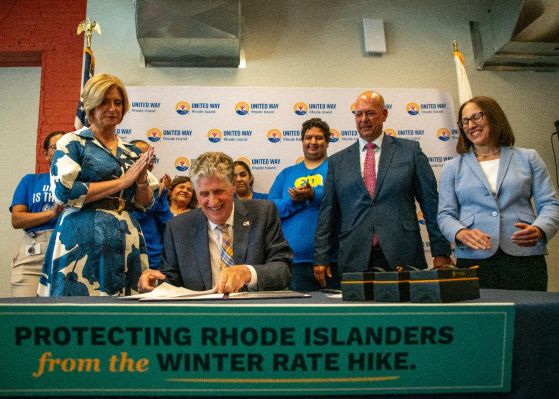
Governor McKee signs an executive order at Thursday’s ceremony at the United Way of Rhode Island in Providence.
Executive Order delivers direct bill relief to every residential electric customer as Rhode Island faces a double-digit winter price spike
PROVIDENCE, RI — Governor Dan McKee today signed an Executive Order directing $28 million in emergency relief to help protect all households from a double-digit winter price spike announced earlier today by Rhode Island Energy. Governor McKee signed the Executive Order at United Way of Rhode Island, whose team works every day to help Rhode Islanders struggling to pay their electric bills.
The Executive Order outlines that Rhode Island is facing an energy affordability crisis driven by some of the highest electricity rates in the nation, years of rapidly rising utility costs, and mounting financial hardship for working families. An extraordinary convergence of events outside the State’s control—including disruptions to global energy markets caused by Trump’s War in Iran, unexpectedly high regional electricity market costs, and other factors—will now drive residential electric rates even higher this winter, creating an emergency that requires immediate action.
“Rhode Islanders have been pushed to the breaking point on energy costs,” said Governor Dan McKee. “Families in our state are paying some of the highest electric bills in the nation and now face another double-digit increase this winter. Too many residents are already choosing between paying the electric bill, buying groceries, or filling a prescription. This Executive Order takes immediate action to protect Rhode Islanders from this energy affordability crisis when they need it most, while we continue fighting for the long-term reforms needed to bring energy costs down.”
The Governor’s Executive Order directs the Office of Energy Resources (OER) to take immediate action before the Public Utilities Commission (PUC) to deliver relief to ratepayers. OER will seek to apply $28 million in available Regional Greenhouse Gas Initiative (RGGI) funds as direct credits for every residential electric customer, reaching more than 450,000 households statewide, during the peak winter heating months when bills are most unmanageable. For the average ratepayer, the approximately $61 in total credits will fully offset the rate increase during the three most expensive winter months.
The Governor’s Executive Order outlines the severe and specific conditions, worsened by the winter rate increase, that led to this emergency action:
- Double-digit winter electricity price spike: Rhode Island Energy announced a double-digit winter price increase of approximately 15 percent compared to last winter, creating a spike during the months when households use and need the most energy. This represents a more than 21 percent bill increase from what Rhode Islanders are paying this summer.
- Compounded impact of rising energy costs: Rhode Island already has the fourth-highest residential electricity rates in the nation, and rates have increased more than 25 percent in just the past three years, more than three times the rate of inflation.
- Growing financial hardship: Residential electric accounts more than 90 days past due have increased by more than 40 percent since May 2023, while the average balance owed has nearly doubled. According to the U.S. Census Bureau, more than one-third of Rhode Island adults reported cutting back on basic necessities such as food or medicine in order to pay an energy bill, the highest rate in New England.
- Surging demand for assistance: United Way Rhode Island reported a nearly 20 percent increase in cold-weather utility assistance requests between 2024 and 2025. Its 2-1-1 line also received more than 5,700 energy-related calls during May and June 2026, nearly five times the number received during the same period last year. The 2025 Rhode Island Life Index found that more than nine in ten Rhode Islanders say difficulty paying utility bills is a challenge facing their community.
- Mounting cost-of-living pressures: Rhode Island families are still recovering from the highest nationwide inflation in decades. More recently, Trump’s War with Iran has driven regional energy prices higher, while federal tariffs have increased the cost of everyday goods, leaving families with even less room in their household budgets before this winter’s rate increase.
- Global energy market disruptions: The conflict involving Iran has driven up crude oil and liquefied natural gas (LNG) prices, increasing costs for New England, which relies heavily on imported LNG during periods of peak winter demand. At the same time, persistent inflation and federal tariffs have continued to drive up the cost of everyday goods, leaving families with even less room in their household budgets.
- Unexpected regional electricity market costs: ISO New England’s Day-Ahead Ancillary Services Initiative (DASI) was projected to cost approximately $140 million in its first year but instead reached nearly $974 million, significantly increasing costs passed on to Rhode Island ratepayers.
In past years, Governor McKee has used more than $15 million in RGGI funds to help low-income Rhode Islanders with their electric bills, which is permitted under statute. Today’s energy crisis is hitting far beyond low-income households. Working families and middle-class Rhode Islanders are also being squeezed. The Governor’s Executive Order expands the allowable use of RGGI funds to provide relief for all residential electric customers across the state. Using these dollars for emergency relief will not disrupt any existing RGGI projects or programs.
Rhode Island is joining other RGGI states that have used these funds in recent years to lower utility bills, including Maryland, New Jersey, Delaware, and Virginia. In January 2026, New Jersey went further by declaring an energy affordability emergency and directing available resources toward ratepayer relief.
McKee Administration Action on Energy
Today’s Executive Order builds on a series of actions Governor McKee has taken to reduce energy costs and provide relief to Rhode Islanders.
- $500 million in long-term energy relief: As part of the FY27 budget and the Governor’s Affordability for All agenda, secured reforms expected to save Rhode Islanders approximately $500 million over the next five years by eliminating unnecessary utility shareholder bonus payments, expanding access to lower-cost energy resources like nuclear and large-scale hydropower, and reducing near-term costs associated with net metering and utility paving projects.
- More than $160 million settlement negotiated for ratepayers: The McKee Administration, through the Division of Public Utilities and Carriers, negotiated a settlement with Rhode Island Energy’s parent company, PPL, that would return more than $160 million to ratepayers, pending final approval by the Public Utilities Commission.
- $37 million in energy tax relief: Suspended the gross receipts tax on energy bills in the FY24 budget, saving Rhode Islanders approximately $37 million.
- $20 million in bill savings: Urged the PUC to reduce the energy efficiency charge on electric bills, delivering approximately $20 million in savings for ratepayers.
- $13.7 million in winter energy relief: Directed nearly $15 million in RGGI funds over several years to help protect Rhode Islanders most vulnerable to rising winter energy costs.
“Emergency relief is needed now, but Rhode Island also needs lasting solutions,” said Governor McKee. “That’s why we are taking action to protect families this winter while continuing the work to build a more affordable energy future for our state.”
What They’re Saying
“United Way of Rhode Island sees firsthand what rising utility costs are doing to working families across our state—utility assistance requests through 211 jumped 315% year-over-year, and Good Neighbor Energy Fund requests rose 354%,” said Cortney Nicolato, President & CEO of United Way of Rhode Island. “While these Fund dollars are built for next season, the need we’re seeing right now can’t wait — United Way is here for you now. If you’re facing a shutoff notice, call 211 today. You are not alone.”
“Westbay Community Action sees firsthand the impact that rising utility costs have on our working families, seniors, and those living on fixed incomes,” said Paul Salera, the President & CEO of Westbay Community Action & Co-President of the RI Community Action Association. “This investment will provide immediate relief and help to ensure that these households can keep their heat on while meeting other basic needs during the upcoming winter months.”
“The Governor has made energy affordability an urgent priority. As the state’s ratepayer advocate, our agency works hard every day to protect Rhode Islanders, and struggling families in particular, from unreasonable utility costs as we see firsthand the fall-out when ratepayers fall irreversibly behind on their bills,” said Linda George, Administrator of Rhode Island Division of Public Utilities and Carriers. “This Executive Order makes good on the Governor’s promise to provide immediate help in the near term to ALL – all while working to implement long-term remedial measures that lessen the energy burdens for hardworking Rhode Islanders.”
“Today’s action reflects the need to address an extraordinary affordability challenge facing individuals and families this upcoming winter with their electricity bills,” said Acting OER Commissioner Chris Kearns. “Rhode Island can meet this moment while we continue OER’s solar, electrification, energy storage, heat pump and clean transportation rebate program investments for Rhode Islanders.”
“Today’s announcement represents an important step in helping Rhode Islanders manage their day-to-day costs of living,” said Department of Human Services Director Kimberly Merolla-Brito. “We all know that it is increasingly more difficult to make ends meet while ensuring we put food on the table, gas in the car, and make preparations for the upcoming heating season. This plan offers some needed relief in the midst of ongoing economic burdens and hopefully will provide a necessary boost for our residents.”
